Cold Email for Insurance: Reaching Carriers and Brokers
The insurance industry has long sales cycles and complex stakeholder maps. Here's how to approach cold email outreach to carriers, MGAs, brokers, and insurtech buyers.
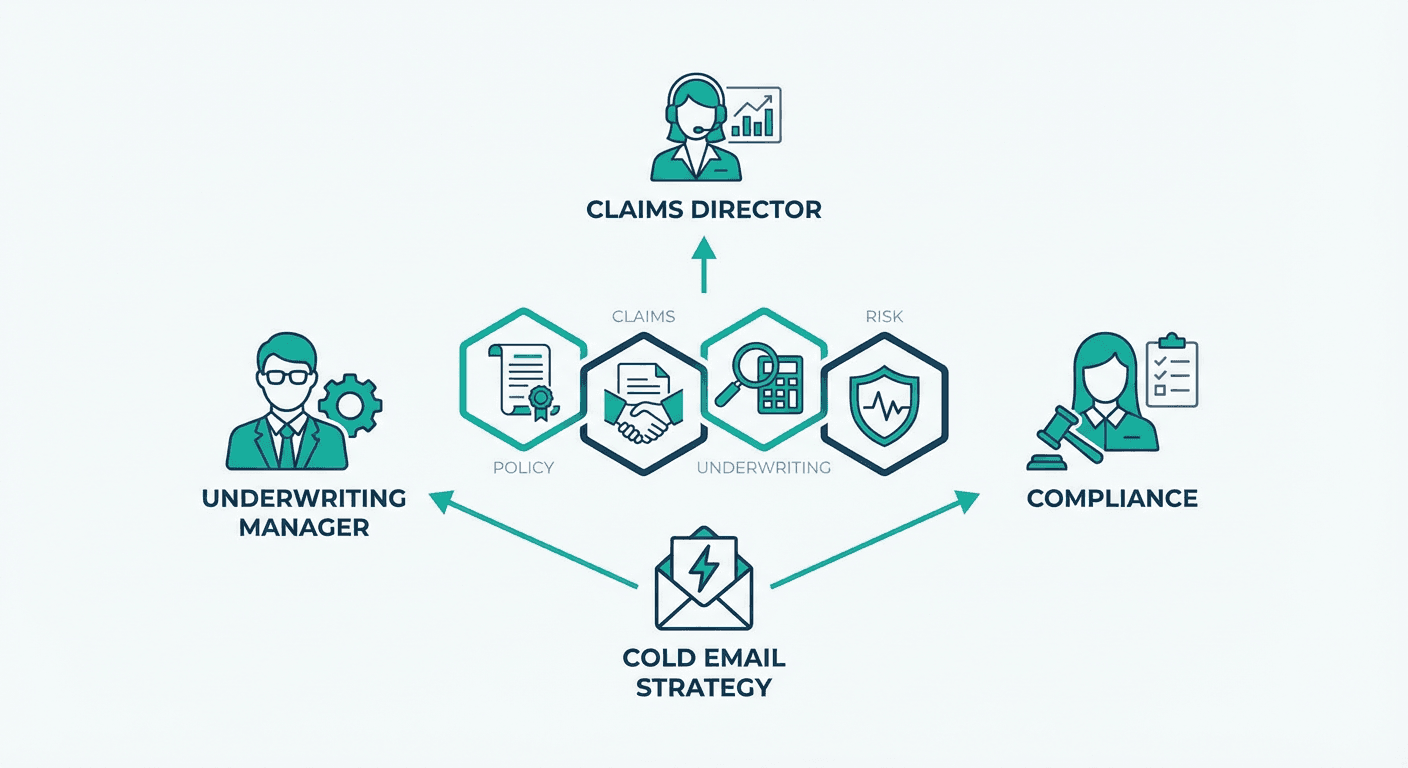
Cold email in insurance requires targeting four distinct buyer types: carriers (12-18 month procurement cycles with multiple approval layers), MGAs/MGUs (faster decisions, more tech-forward), brokers/agencies (relationship-focused, time-constrained during renewals), and insurtech companies (fastest procurement, venture-backed). Success depends on understanding state-level regulation, timing outreach around renewal and budget cycles, and demonstrating regulatory compliance without leading with it. Credibility comes from using industry terminology, citing NAIC model laws, and showing state-specific deployment experience.
Key takeaways
- Insurance carriers typically have procurement cycles lasting 12 to 18 months for enterprise technology, requiring outreach to multiple stakeholders including CIO, Chief Underwriting Officer, VP of Claims, and Chief Actuary.
- Insurance is regulated at the state level rather than federally, meaning solutions must often demonstrate compliance across all 50 states with different requirements in each jurisdiction.
- MGAs and MGUs make decisions faster than traditional carriers and tend to be more technology-forward, often representing younger organizations with more openness to innovation.
- Insurtech companies represent the fastest procurement segment with higher technology literacy, venture backing creating growth pressure, and willingness to build tech stacks from scratch.
- Demonstrating regulatory awareness in emails should acknowledge NAIC Model Laws and state compliance requirements without making compliance the central pitch focus.
Reviewed and updated September 1, 2026
Cold Email for Insurance: Reaching Carriers, Brokers, and Insurtech Companies
Insurance is one of the most relationship-driven industries in B2B sales.
Carriers have been working with the same technology vendors for decades. Brokers rely on trusted partnerships built over years. MGAs operate within tightly regulated frameworks where every vendor relationship carries compliance implications.
Breaking into this industry through cold email requires understanding the distinct buyer types, their procurement processes, and the seasonal rhythms that govern their purchasing decisions.
This guide covers the insurance landscape, from traditional carriers to emerging insurtech companies, and provides specific strategies for cold email outreach that works.
The Insurance Industry Landscape

Before writing a single email, you need to understand who you are selling to. The insurance industry is not monolithic, and your approach must differ based on the buyer type.
Insurance Carriers
Carriers are the companies that actually underwrite and pay claims. They range from massive multiline insurers to specialty carriers focused on niche markets like cyber insurance or professional liability.
Characteristics:
- Long procurement cycles (often 12 to 18 months for enterprise technology)
- Multiple approval layers including underwriting, claims, IT, compliance, and legal
- Heavy regulatory oversight from state insurance departments
- Conservative culture that values stability over innovation
- Large legacy technology investments that create switching costs
Key decision-makers:
- Chief Information Officer (CIO) for technology decisions
- Chief Underwriting Officer (CUO) for underwriting tools
- VP of Claims for claims management solutions
- Chief Actuary for pricing and analytics tools
- Chief Operating Officer (COO) for operational efficiency solutions
Managing General Agents (MGAs) and Managing General Underwriters (MGUs)
MGAs and MGUs are intermediaries that have underwriting authority from carriers. They operate with more autonomy than traditional agencies and often specialize in specific lines of business.
Characteristics:
- Faster decision-making than carriers
- Technology-forward mindset (often younger organizations)
- Need to demonstrate value to carrier partners
- Growing segment of the market
- More open to innovative solutions
Key decision-makers:
- CEO or President (often involved in all major decisions)
- Chief Underwriting Officer
- Operations Director
- Head of Technology (if they have one)
Insurance Brokers and Agencies
Brokers and agencies sell insurance products to businesses and individuals. They range from massive global brokers to regional agencies with a few employees.
Characteristics:
- Revenue driven by commissions and fees
- Highly relationship-focused
- Technology adoption varies widely by size and geography
- Time-constrained during renewal seasons
- Often family-owned or partnership structures
Key decision-makers:
- Agency Principal or Owner
- VP of Sales or Business Development
- Operations Manager
- Producer (for individual sales tools)
Insurtech Companies
Insurtech refers to technology-first companies that are either carriers, MGAs, or service providers focused on modernizing insurance. They represent a distinct buyer category.
Characteristics:
- Faster procurement processes
- Higher technology literacy
- Venture-backed with growth pressure
- More willing to try new vendors
- Often building their tech stack from scratch
Key decision-makers:
- CEO and Founders
- VP of Engineering or CTO
- Head of Product
- VP of Operations
Regulatory Considerations
Insurance is one of the most heavily regulated industries in the United States. Unlike banking, which has federal oversight, insurance is primarily regulated at the state level by state insurance departments.
State-Level Regulation
Each state has its own insurance department that oversees carriers operating within its borders. This creates complexity because:
- Products must be filed and approved in each state
- Rate changes require regulatory approval
- Consumer complaint handling is monitored
- Financial solvency is reviewed regularly
- Market conduct examinations occur periodically
When selling to carriers, you need to understand that any solution touching pricing, underwriting, or claims may have regulatory implications. Your prospects will ask about this.
Data Privacy Requirements
Insurance companies hold sensitive personal and financial information. HIPAA applies to health insurers. State privacy laws (like CCPA in California) affect how customer data can be handled.
If your solution processes or stores customer data, you will need to demonstrate compliance with relevant privacy regulations. This is similar to fintech, but the specific regulations differ.
NAIC Model Laws
The National Association of Insurance Commissioners (NAIC) develops model laws that states often adopt. These cover areas like:
- Data security requirements
- Market conduct standards
- Claims handling practices
- Producer licensing
- Corporate governance
Familiarity with NAIC model laws demonstrates industry knowledge and can differentiate your outreach.
How to Address Regulation in Your Emails
Do not ignore regulation, but do not lead with it either (unless selling compliance solutions). Instead, briefly acknowledge that you understand the regulated environment.
Example:
"Built for state-level compliance requirements across all 50 states."
Example:
"NAIC Model Law compliant data handling."
Example:
"Already deployed at carriers in [X] states."
This signals awareness without making compliance the focus of your pitch.
Understanding Insurance Buying Cycles
Insurance companies operate on distinct cycles that affect when they buy and what they prioritize.
The Renewal Cycle
Insurance is fundamentally a renewal business. Policies typically renew annually, and the period leading up to renewal is intense for everyone involved.
For carriers:
- Q4 and Q1 are often busiest for property and casualty renewals
- Health insurance renewals cluster around open enrollment
- Underwriters and operations teams are stretched thin during peak renewal periods
For brokers:
- Commercial renewals often cluster in Q1 and Q4
- Group benefits renewals typically occur in Q4 (for January 1 effective dates)
- Personal lines spread more evenly but spike at policy anniversaries
Timing implication: Avoid outreach during peak renewal seasons. Brokers in October and November are focused on open enrollment. P&C underwriters in December are closing out the year. Your email will get lost.
Budget Cycles
Most insurance companies operate on calendar year budgets, with planning occurring in Q3 and Q4.
Strategic outreach windows:
- Q2 and early Q3: Decision-makers have bandwidth and can consider new initiatives for next year
- Q4: Budget is being finalized, good for solutions that fit into planned initiatives
- Q1: New budget available, early execution on approved projects
Challenging windows:
- Late Q3: Heads-down on planning, less time for new conversations
- Peak renewal periods: No bandwidth for anything not urgent
Soft Market vs. Hard Market
The insurance market cycles between "soft" (competitive, lower prices, easier to get coverage) and "hard" (restricted, higher prices, stricter underwriting).
In a hard market:
- Carriers are focused on underwriting discipline
- Profitability is prioritized over growth
- Appetite for risk-reduction and efficiency tools increases
- Underwriting automation and analytics are in demand
In a soft market:
- Carriers compete aggressively for business
- Growth is prioritized
- Sales enablement and distribution tools are in demand
- Customer experience investments increase
Tailor your messaging to the current market cycle. Hard market messaging should focus on loss control, underwriting precision, and operational efficiency. Soft market messaging should emphasize growth, customer acquisition, and competitive differentiation.
- Carriers are focused on underwriting discipline
- Profitability is prioritized over growth
- Appetite for risk-reduction and efficiency tools increases
- Hard market messaging should focus on loss control, underwriting precision, and operational efficiency.
- Carriers compete aggressively for business
- Growth is prioritized
- Sales enablement and distribution tools are in demand
- Soft market messaging should emphasize growth, customer acquisition, and competitive differentiation.
Key Decision Makers and Their Priorities

Chief Information Officer (CIO)
What they care about: System reliability, cybersecurity, technology modernization, vendor consolidation, total cost of ownership.
Pain points: Legacy system maintenance, integration complexity, talent retention, security threats, regulatory technology requirements.
Email angle: Focus on integration with existing systems, security posture, and long-term total cost of ownership. CIOs at carriers are cautious about adding new vendors.
Chief Underwriting Officer (CUO)
What they care about: Underwriting profitability, risk selection accuracy, pricing adequacy, operational efficiency, regulatory compliance.
Pain points: Manual underwriting processes, inconsistent risk assessment, inadequate pricing tools, submission overload, data quality issues.
Email angle: Focus on underwriting accuracy, speed to quote, and loss ratio improvement. CUOs respond to solutions that demonstrably improve underwriting outcomes.
VP of Claims
What they care about: Claims cycle time, customer satisfaction, fraud detection, reserve accuracy, litigation management.
Pain points: Manual claims processing, fraudulent claims leakage, customer complaints, regulatory examinations, rising legal costs.
Email angle: Focus on efficiency, accuracy, and customer experience. Claims leaders want to process legitimate claims faster while catching fraud.
Chief Actuary
What they care about: Pricing accuracy, reserve adequacy, loss trend analysis, regulatory filings, catastrophe modeling.
Pain points: Data quality issues, model validation requirements, regulatory scrutiny, talent shortage, emerging risk quantification.
Email angle: Focus on data quality, analytical capabilities, and regulatory compliance. Actuaries appreciate technical precision and quantified results.
VP of Distribution or Sales
What they care about: Premium growth, agent and broker relationships, channel performance, market penetration, competitive positioning.
Pain points: Agent retention, distribution management complexity, competitive pressure, market access, quote turnaround time.
Email angle: Focus on growth enablement, broker satisfaction, and competitive advantages in the market.
Agency Principals and Owners
What they care about: Revenue growth, profitability, client retention, operational efficiency, succession planning.
Pain points: Time constraints, technology complexity, carrier relationships, talent recruitment, competition from direct writers.
Email angle: Focus on revenue growth, time savings, and client retention. Agency owners respond to solutions that help them grow their book of business.
Building Credibility in Insurance
The insurance industry is skeptical of outsiders. Here is how to establish credibility quickly.
Industry-Specific References
Generic case studies will not work. Insurance buyers want to see that you understand their world.
Weak:
"We work with Fortune 500 companies across multiple industries."
Strong:
"Currently deployed at three regional P&C carriers and two specialty MGAs."
If you work with recognizable insurance companies, name them (with permission). If you work with a notable insurtech, that counts too.
Regulatory Understanding
Demonstrate that you understand the compliance environment.
Example:
"Built for state insurance department examination requirements."
Example:
"Compliant with NAIC cybersecurity model law requirements."
Industry Terminology
Use terminology correctly. Insurance has specific language that signals whether you know the industry.
Do:
- Refer to "loss ratio" rather than "claims costs"
- Use "submission" for business sent to underwriters
- Know the difference between "admitted" and "non-admitted" carriers
- Understand what an "A.M. Best rating" means
Do not:
- Confuse brokers and agents
- Misuse actuarial terminology
- Get basic product types wrong
Association and Partnership Credentials
Insurance has well-established industry associations. Membership or partnerships with these organizations adds credibility.
Notable organizations:
- ACORD (data standards organization)
- Insurance Information Institute (III)
- National Association of Professional Insurance Agents (PIA)
- Independent Insurance Agents & Brokers of America (IIABA)
- American Association of Managing General Agents (AAMGA)
If you are an ACORD partner or integrated with ACORD standards, mention it. If you have spoken at industry events or contributed to industry publications, reference it.
Email Templates for Insurance
Template 1: Carrier CIO Approach
Subject: [Specific technology challenge] at [Company]
Body:
[First Name],
Noticed [Company] is [observable trigger: expanding into new states, launching new products, modernizing systems].
We help regional carriers like [relevant reference customers] address [specific technology challenge]. Currently integrated with [relevant core systems they likely use].
Typical implementation: 6 months to production, no disruption to existing operations.
Worth a 20-minute conversation to explore fit?
[Your name]
Deliverability for these carrier outreach sequences depends on inbox reputation, a topic covered in tools that warm up sender domains.
Why it works: Addresses the CIO's concern about disruption, references relevant similar customers, shows understanding of their technology environment.
Template 2: Underwriting Focus
Subject: Submission triage at [Company]
Body:
[First Name],
Quick question: what percentage of submissions does your team decline without quoting?
We help specialty carriers reduce that number while improving the quality of quotes issued. [Reference customer] improved their submission-to-bind ratio by [X%] using our platform.
Built specifically for [their specialty line: cyber, professional liability, etc.].
Worth exploring?
[Your name]
Why it works: Opens with a relevant question that underwriters think about, shows understanding of their specialty, provides specific proof point.
Template 3: MGA/MGU Approach
Subject: [Specific operational challenge] for [specialty line] MGAs
Body:
[First Name],
MGAs focused on [their specialty] typically struggle with [specific operational challenge: binding authority tracking, compliance documentation, carrier reporting].
We work with [X] MGAs including [relevant reference if available] on exactly this challenge.
Would you be open to a quick call to see if there is fit?
[Your name]
Why it works: Shows understanding of the MGA model, references their specific specialty, acknowledges common pain points.
Template 4: Broker/Agency Approach
Subject: [Specific benefit] for [location] agencies
Body:
[First Name],
[Trigger: saw your agency was named to Best Practices, noticed your growth in [specialty], saw you joined the Big I].
We help independent agencies [specific benefit: quote faster, retain more clients, grow commercial lines].
[Reference customer in similar market] increased [specific metric] by [amount] last year.
Worth a 15-minute call?
[Your name]
Why it works: Personalizes with observable trigger, focuses on outcomes agencies care about, respects their time with short meeting request.
Template 5: Insurtech Approach
Subject: [Technical capability] for insurtech infrastructure
Body:
[First Name],
Building insurance infrastructure from scratch means choosing vendors carefully. Wrong choices create technical debt that slows you down later.
We work with [X] insurtech companies on [specific technical capability]. Our API is built for the speed you need.
Happy to share documentation and sandbox access before any call.
[Your name]
Why it works: Speaks to the insurtech mindset, addresses their concern about technical debt, offers concrete resources upfront.
Template 6: Claims Focus
Subject: Claims cycle time at [Company]
Body:
[First Name],
What is your average claims cycle time for [specific claim type they handle]?
We help carriers reduce cycle time while improving customer satisfaction scores. [Reference customer] reduced average cycle time from [X] days to [Y] days.
Built for [specific line of business] claims with integration to [relevant systems].
Worth exploring?
[Your name]
Why it works: Opens with question claims leaders care about, provides specific proof point, shows understanding of their claims type.
Common Mistakes to Avoid
Mistake 1: Treating All Insurance Buyers the Same
A carrier CIO has different priorities than an agency owner. An MGA underwriter thinks differently than a claims VP at a national carrier. Segment your outreach and tailor your messaging accordingly.
Because messaging must be segmented and tested across buyer types, choosing the right sending platform helps manage that outreach without added complexity.
Mistake 2: Ignoring the Renewal Cycle
Reaching out to brokers during open enrollment or to P&C underwriters during January renewals will get poor results. Time your outreach to their availability.
Mistake 3: Underestimating Relationship Dynamics
Insurance buying often depends on existing relationships. A carrier may continue with a mediocre vendor because the relationship is decades old. Your cold email needs to overcome this inertia.
Mistake 4: Overselling Innovation
Many insurance professionals are skeptical of "innovation" and "disruption." They have seen technologies come and go while their core business remains largely unchanged. Focus on practical outcomes rather than revolutionary claims.
Mistake 5: Missing Regulatory Implications
If your solution affects underwriting, claims, or pricing, there may be regulatory considerations. Understand these before your outreach and be prepared to address them.
Mistake 6: Ignoring Implementation Concerns
Insurance companies have been burned by failed implementations. Address concerns about integration, timeline, and disruption proactively.
Building a Long-Term Insurance Sales Strategy
Start with Your Best Fit
The insurance market is vast. Do not try to sell to everyone. Identify where your solution provides the most value:
- Which buyer type (carrier, MGA, broker, insurtech)?
- Which line of business (P&C, life, health, specialty)?
- Which company size (enterprise carrier, regional carrier, large agency, small agency)?
- Which function (underwriting, claims, distribution, operations)?
Focus your initial outreach on segments where you have proof points or clear product fit.
Build Industry Relationships
Insurance professionals trust referrals from colleagues. Invest in building relationships beyond your immediate sales targets:
- Attend industry events (RIMS, WSIA, PCI, ITC)
- Contribute to industry publications
- Engage with industry associations
- Build relationships with consultants who advise insurance companies
These relationships create warm introductions that outperform cold outreach.
Develop Case Studies
Insurance buyers want to see results from similar organizations. As you win customers, document their outcomes carefully:
- Quantify results (loss ratio improvement, cycle time reduction, premium growth)
- Get permission to reference them by name
- Develop detailed case studies for your best customers
- Create segment-specific proof points
Nurture Long-Term Prospects
Insurance deals take time. A prospect who says no today may be ready in 18 months when their current contract expires or when a regulatory change affects them.
Build systems for staying in touch:
- Share relevant industry news
- Send occasional value-add content (not sales pitches)
- Engage on LinkedIn with thoughtful comments
- Track contract renewal dates and reach back out at the right time
Measuring Success
Track metrics that reflect the insurance sales cycle:
Early indicators:
- Open rates by segment
- Reply rates by buyer type
- Meeting conversion rates
- Qualification rates (does the prospect have budget, authority, need, and timeline?)
Pipeline metrics:
- Opportunities created
- Average deal size by segment
- Sales cycle length
- Win rate against specific competitors
Revenue metrics:
- Closed deals
- Revenue by segment
- Expansion revenue from existing customers
- Customer retention
Insurance sales cycles are long, so early indicators matter for course correction. But ultimately, measure what matters: closed revenue from your target segments.
Summary
Cold emailing insurance companies requires industry-specific knowledge and patient execution. Success depends on:
- Understanding buyer types and tailoring your approach to carriers, MGAs, brokers, and insurtechs differently
- Respecting the regulatory environment and demonstrating compliance awareness
- Timing outreach strategically around renewal cycles and budget planning
- Building credibility through industry references, terminology, and association connections
- Targeting the right decision-makers with role-appropriate messaging
- Playing the long game with relationship building and consistent follow-up
Insurance professionals value relationships, stability, and proven results. Your cold email is the first step in building that relationship. Make it count by demonstrating that you understand their world and can deliver tangible outcomes.
The vendors who succeed in insurance are those who invest in learning the industry, build genuine expertise, and approach outreach with patience and professionalism.
Related Reading
- Cold Email for InsurTech Companies: 2026 Strategy Guide
- Cold Email for Telecom: Reaching Carriers, MSPs, and Communications Providers
- Cold Email for SaaS Companies: The Complete Guide to B2B Outreach
If you would rather have this run for you, RevenueFlow books qualified meetings on a pay-per-meeting basis and publishes client results.
Frequently asked questions.
Frequently asked questions- How long does it take to close a sale with an insurance carrier?
- Insurance carriers typically have procurement cycles lasting 12 to 18 months for enterprise technology purchases. These extended timelines result from multiple approval layers that include underwriting, claims, IT, compliance, and legal departments, plus heavy regulatory oversight from state insurance departments. Carriers maintain a conservative culture that values stability over innovation, creating additional evaluation time.
- What's the difference between selling to an MGA versus a traditional insurance carrier?
- MGAs (Managing General Agents) make decisions significantly faster than traditional carriers and tend to be more technology-forward, often representing younger organizations. They operate with underwriting authority from carriers but have more autonomy than traditional agencies. MGAs are generally more open to innovative solutions and have fewer approval layers, though they still need to demonstrate value to their carrier partners.
- Do I need to mention regulatory compliance in cold emails to insurance companies?
- You should briefly acknowledge regulatory awareness without making it the central focus of your pitch, unless you're specifically selling compliance solutions. Effective approaches include mentioning state-level compliance across all 50 states, NAIC Model Law compliance, or existing deployment at carriers in multiple states. This signals industry knowledge and differentiates your outreach without overwhelming the recipient with compliance details.
- Who are the key decision makers at insurance carriers?
- Insurance carrier decisions involve multiple executives depending on the solution category: Chief Information Officer for technology decisions, Chief Underwriting Officer for underwriting tools, VP of Claims for claims management, Chief Actuary for pricing and analytics, and Chief Operating Officer for operational efficiency solutions. This multi-stakeholder structure contributes to the 12-18 month procurement cycles typical at carriers.
- Are insurtech companies easier to sell to than traditional insurance carriers?
- Yes, insurtech companies represent a distinct and faster-moving buyer category. They have shorter procurement processes, higher technology literacy, and greater willingness to try new vendors. Most are venture-backed with growth pressure and are building their tech stacks from scratch rather than replacing legacy systems. Key decision makers include the CEO and founders, VP of Engineering or CTO, Head of Product, and VP of Operations.
About the author.

Fernando Cao is CEO at RevenueFlow, which builds and operates outbound revenue engines for B2B companies. Previously at Accenture Strategy. Studied at University of Bath.
Fernando Cao · CEO
Connect on LinkedIn →Explore more.
Ready to scale your outreach?
We build GTM engines that book real meetings. See the receipts.
Related articles.
Cold Email for Telecom: Reaching Carriers and MSPs
Telecom companies face rapid technology changes and competitive pressures. Here's how to approach cold email outreach to carriers, MSPs, and UCaaS providers.
Cold Email for Architecture Firms: 2026 Strategy Guide
Architecture firms buy on project phases rather than fiscal quarters. How to build a list, time the spec window, and write cold emails principals answer.
Cold Email for Trucking and Fleet Companies: 2026 Guide
How to reach carriers, fleet operators, and safety buyers with cold email: FMCSA-driven list building, trigger timing, four templates, and compliance.
Cold Email for Cannabis Companies: 2026 Strategy Guide
The April 2026 rescheduling order split cannabis buyers into two tax realities. Here is how to segment, list-build, and write cold email for each.
Cold Email for Private Equity Firms: 2026 Strategy Guide
How to run cold email into private equity: mapping fund-level and portfolio-level buyers, list sources, four templates, and PE-specific deliverability rules.
Cold Email for Wealth Management Firms: 2026 Strategy Guide
RIAs are 16,500+ mostly small firms with public Form ADV data, small buying committees, and a compliance gate. How to run cold email into wealth management.