What a B2B Lead Generation Agency Costs (2026 Pricing)
2026 lead generation agency pricing: retainer, pay-per-lead, pay-per-appointment and hybrid ranges, plus the cost-per-meeting math that compares them.
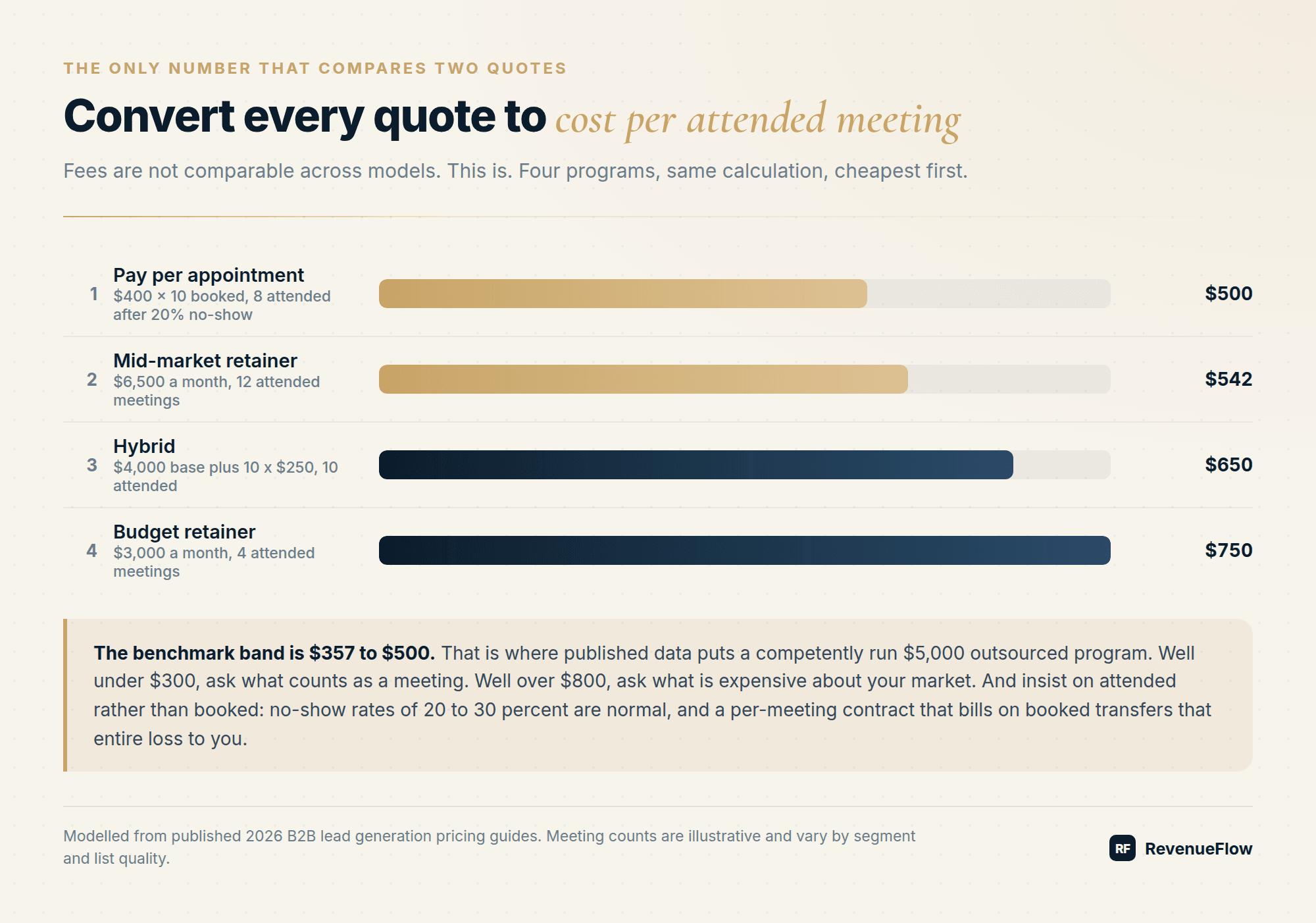
B2B lead generation agencies charge $3,500 to $12,000 per month on retainer in 2026, with omnichannel programs above $20,000. Performance models run $150 to $600 per qualified lead or $300 to $900 per booked appointment. A competently run $5,000 program lands near $357 to $500 per attended meeting.
Key takeaways
- Monthly retainers cluster at $3,500 to $12,000 in 2026, with full omnichannel lead generation programs running past $20,000 per month.
- Performance pricing runs $150 to $600 per qualified lead and $300 to $900 per booked appointment, rising above $1,000 for verified decision-maker meetings.
- Three-month minimums and a paid ramp month are near universal, so a $5,000 monthly quote is really a $15,000 commitment with results starting in month two.
- Cost per attended meeting is the only figure that compares quotes across models, and a well-run $5,000 program benchmarks at $357 to $500.
- No-show rates of 20 to 30 percent on cold-sourced meetings mean per-meeting contracts should bill on attendance, not on bookings.
- Segment drives price more than anything else: published guides put SMB meetings near $150 and enterprise meetings at $2,500 or more.
Reviewed and updated September 5, 2026
What a B2B Lead Generation Agency Actually Costs (2026 Pricing Breakdown)
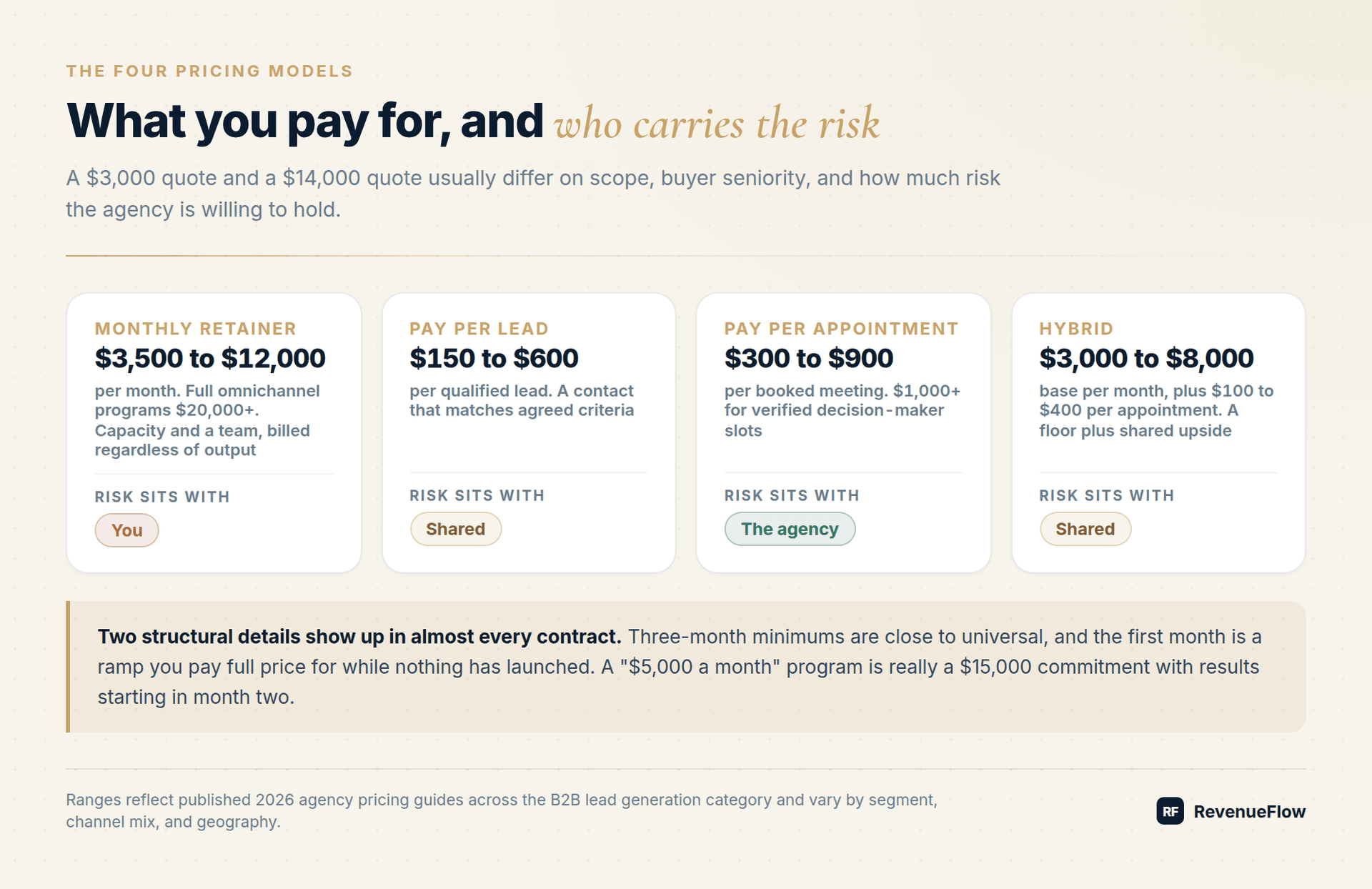
Nobody publishes a price list, so buyers end up comparing a $3,000 quote against a $14,000 quote with no idea what the difference buys. Usually the difference is scope, seniority of the target buyer, and how much risk the agency is willing to carry.
Here is the 2026 market, model by model, with the ranges you should expect to see on a proposal and the questions that make two quotes comparable.
A lead generation cost per lead figure is only comparable between two agencies once both are quoting the same lead definition, which is why the per-meeting unit settles the comparison the per-lead unit reopens.
If you are reading this as one of the agency owners it is written for, the persona-specific version of this playbook lives in our guide to outbound for agency owners.
The four pricing models
| Model | Typical 2026 range | You are paying for | Risk sits with |
|---|---|---|---|
| Monthly retainer | $3,500 to $12,000/mo, full omnichannel programs $20,000+ | Capacity and a team, billed regardless of output | You |
| Pay per lead | $150 to $600 per qualified lead | A contact that matches agreed criteria | Shared |
| Pay per appointment | $300 to $900 per booked meeting, $1,000+ for verified decision-maker slots | A calendar slot | The agency |
| Hybrid | $3,000 to $8,000 base plus $100 to $400 per appointment | A floor plus shared upside | Shared |
Two structural details show up in almost every contract and are worth knowing before you negotiate. Three-month minimums are close to universal, and the first month is a ramp you pay full price for while nothing has launched. Budget accordingly: a "$5,000 a month" program is really a $15,000 commitment with results starting in month two.
Segment moves these numbers more than anything else. Published 2026 guides put SMB meetings near $150 and enterprise meetings at $2,500 or more. The driver is not agency greed, it is contact rate. A VP at a 5,000-person company takes ten times the touches of an owner-operator at a 20-person firm.
Buyers ask directly whether outbound pricing changes by target company size, and it does, for the reason above rather than for a commercial one: contact rate falls as seniority and company size rise, so the same programme buys fewer conversations per month at the top of the range and the per-meeting figure moves with it.
What sits inside a retainer
A lead generation package is a retainer with the contents named on the outside, so read the list below against whatever the package promises and treat anything missing from it as work you have kept.
- Yes: Strategy and ICP work. Days one to fourteen, and the highest-leverage hours in the engagement.
- Yes: Data. List building, enrichment, and verification.
- Yes: Infrastructure. Domains, mailboxes, DNS authentication, warmup, and sending platform.
- Yes: Copy and creative. Sequences per segment, refreshed as angles fatigue.
- Yes: Operations. Daily sending, rotation, bounce monitoring, and domain hygiene.
- Yes: Reply handling and booking. Classification, responses, no-show chasing, and rebooking.
A mid-market retainer between $5,000 and $8,000 typically covers six cost centres. When a quote comes in far below the range, one of these has been dropped or handed back to you.
Strategy and ICP work. Days one to fourteen, and the highest-leverage hours in the engagement.
Data. List building, enrichment, and verification. Priced per contact, so it scales with volume rather than with headcount.
Infrastructure. Domains, mailboxes, DNS authentication, warmup, and sending platform. Market rates run $10 to $15 per domain per year and $1.90 to $8.40 per mailbox per month depending on provider. The full stack is broken out in the cold email pricing guide for 2026.
Copy and creative. Sequences per segment, refreshed as angles fatigue.
Operations. Daily sending, rotation, bounce monitoring, and domain hygiene. This is the labour line, and it is the one that gets thin on cheap accounts.
Reply handling and booking. Classification, responses, no-show chasing, and rebooking.
Agencies that quote below roughly $2,500 are usually running a shared operator across many accounts, using a template library rather than written copy, or passing infrastructure and data through as extras. None of that is dishonest, but it changes what you are buying.
Which is what to do with the objection that a quote is high compared to what others charge. The comparison is only meaningful once both quotes cover the same six cost centres, and the cheaper one has usually moved one or more of them onto your side of the line or onto a separate invoice. Ask each vendor which of the six sits inside the number and which is billed on top, whether domains, mailboxes and data are included or passed through, and whether campaign setup is charged separately from the per-meeting fee. Two quotes normalised that way frequently invert, and the answer is available before any negotiation starts.
Cost per meeting is the only number that compares two quotes
The same question arrives as how much each qualified meeting actually costs, and the table above is the only way to answer it across two differently shaped quotes, since a retainer and a per-meeting rate are not comparable until both are divided by attended meetings.
Buyers asking what a qualified attended meeting costs are asking for the figure in the last column, and the word attended is doing the work: a per-meeting contract that bills on booked transfers the no-show loss to the buyer.
Shopping for the cheapest lead generation is the same mistake as comparing two retainers on the monthly figure, because the number that decides whether either was cheap is the cost per meeting that came out of it.
Fees are not comparable across models. Cost per attended meeting is. Convert every quote to that number and the picture clarifies immediately.
| Program | Monthly cost | Attended meetings | Cost per attended meeting |
|---|---|---|---|
| Budget retainer | $3,000 | 4 | $750 |
| Mid-market retainer | $6,500 | 12 | $542 |
| Pay per appointment | $400 x 10 booked | 8 attended after 20% no-show | $500 |
| Hybrid | $4,000 base plus 10 x $250 | 10 | $650 |
Published benchmarks put a competently run $5,000 outsourced program in the $357 to $500 per meeting band. If a vendor is quoting you a number well under $300, ask what counts as a meeting. If it is well over $800, ask what is expensive about your market, because sometimes the answer is legitimate (enterprise security buyers, regulated finance) and sometimes it is a thin list.
Insist on attended rather than booked. No-show rates of 20 to 30 percent on cold-sourced meetings are normal, and a per-meeting contract that bills on booked transfers that entire loss to you.
The costs that do not appear on the proposal
When a buyer says the price point seems high compared with other agencies, the useful response is the band above plus one question about what the cheaper quote counts as a meeting, since the gap is normally in the definition rather than in the margin.
A quote can also be priced too low to be credible, and the same question answers both directions: ask what counts as a meeting, because an unusually low rate is normally a looser definition rather than a better price.
- Your time. Two to four hours a week of feedback, ICP corrections, and reply escalations. Programs where the client disappears underperform, reliably.
- The ramp. Warmup plus the first learning cycle means month one produces almost nothing. Judge months two to four.
- CRM and calendar hygiene. Someone has to reconcile booked meetings against attended and closed. If nobody does, you will renew on the wrong number.
- Sales capacity. Meetings you cannot staff are the most expensive line in the whole exercise.
- Contract exit. Ask what happens to the domains and the sequences when you leave. If the domains are theirs, you restart warmup somewhere else.
What actually drives the price up
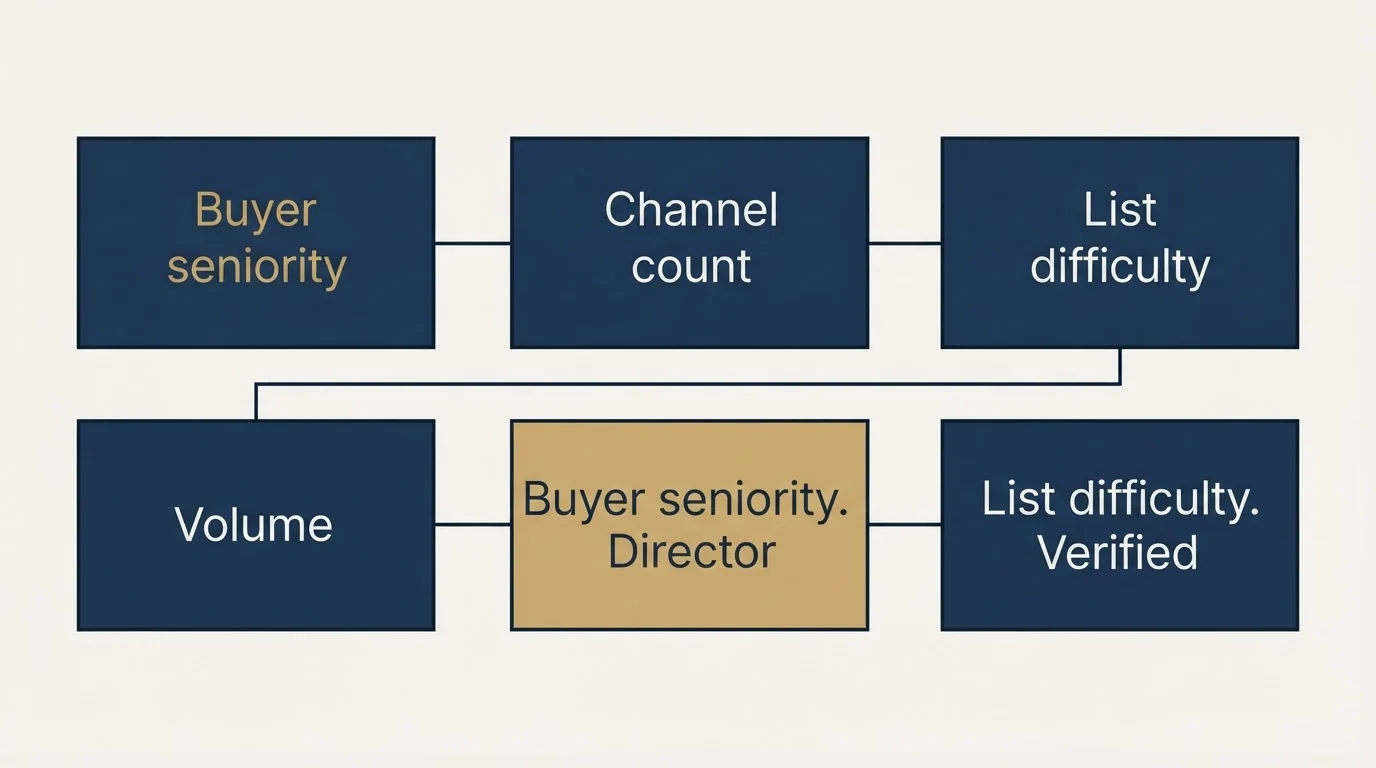
Four variables explain most of the spread between a $3,500 quote and a $14,000 one.
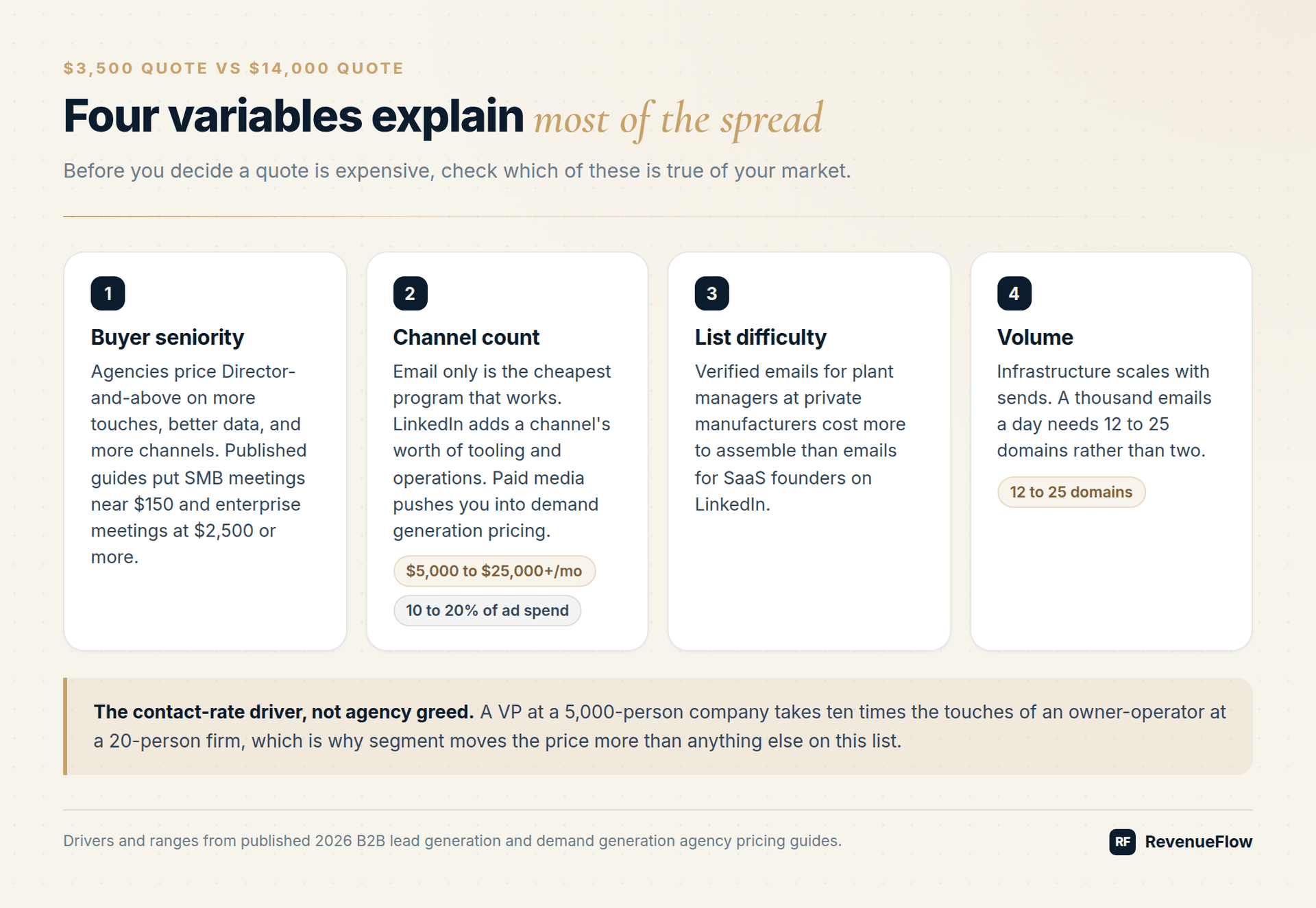
- Buyer seniority. Director and above needs more touches, better data, and more channels.
- Channel count. Email only is the cheapest program that works. Adding LinkedIn roughly adds a channel's worth of tooling and operations. Adding paid media pushes you into demand generation pricing, which starts at $5,000 and runs past $25,000 a month, often with a 10 to 20 percent management fee on ad spend. The distinction is covered in demand generation agency vs cold outbound.
- List difficulty. Verified emails for plant managers at private manufacturers cost more to assemble than emails for SaaS founders on LinkedIn.
- Volume. Infrastructure scales with sends, and 1,000 emails a day needs 12 to 25 domains rather than two.
Comparing quotes: five questions
- What is your definition of a qualified lead or meeting, in writing, before launch?
- Are domains, mailboxes, data, and the sending platform inside the fee or billed on top?
- What was the median cost per attended meeting across your last five clients in our segment?
- Who handles replies, and who chases a no-show?
- What is the minimum term, and what does the ramp month include?
Any agency that will not answer the first two in writing is not a pricing problem, it is a scope problem.
When a lead generation agency is the wrong purchase
We sell done-for-you outbound and charge only for qualified meetings that are attended, so this section is against our own interest. It is also true.
- Deals under roughly $3,000 with no expansion. At $500 per meeting and a 20 percent close rate, acquisition costs $2,500 before anyone does any work. The maths does not close.
- A market under about 1,500 accounts. Volume outbound burns a small list quickly. Hire one strong named-account seller instead.
- A product with no repeatable pitch yet. If founders have not closed ten deals themselves, an agency will be running experiments at your expense with a longer feedback loop than you can afford.
- A pipeline problem that is really a conversion problem. If meetings already arrive and do not close, more meetings makes the leak bigger. Start with the four frameworks that fix broken lead generation.
- No sales capacity. Book the calendar you can actually staff.
Set the target before you sign
Work backwards. Revenue target divided by average contract value gives closed deals. Divide by close rate to get attended meetings. Multiply by your quoted cost per attended meeting, and compare that number to what you were about to spend. If the target implies 40 meetings a month in a market of 900 accounts, the plan is wrong before the agency is chosen.
For what returns look like once a program is running, cold email ROI benchmarks and revenue per dollar spent by industry give the realistic distribution. If the shortlist is really agency versus a first hire, run the numbers in outsourced SDR vs in-house. And if you are pricing email specifically rather than a full program, what a cold email agency costs is the narrower version of this page.
We charge only for qualified meetings that are actually attended, with the definition agreed in writing before launch. Activity is our cost to manage, not your bill. See if you qualify for a free campaign.
Ranges reflect published 2026 agency pricing guides across the B2B lead generation category and vary by segment, channel mix, and geography.
Frequently asked questions.
Frequently asked questions- How much does a lead generation agency cost per month?
- Most B2B lead generation retainers fall between $3,500 and $12,000 per month in 2026, with budget programs from $2,000 and full omnichannel engagements above $20,000. Three-month minimums are standard and the first month is usually a paid ramp, so treat the quoted monthly figure as one third of your real initial commitment.
- Is pay per meeting better than a retainer?
- Pay per meeting shifts delivery risk to the agency and typically costs $300 to $900 per booked appointment. It works when your sales process is proven and you want variable cost. Retainers suit teams that want guaranteed capacity. Convert both to cost per attended meeting before comparing, and require attendance rather than bookings as the billing trigger.
- What is a good cost per meeting for B2B outbound?
- Published 2026 benchmarks put a competently run outsourced program at roughly $357 to $500 per meeting for mid-market targets. SMB meetings can land near $150 and enterprise meetings run $1,000 to $2,500 or more. Anything far below $300 usually means a loose definition of what counts as a meeting.
- What is included in a lead generation agency retainer?
- A mid-market retainer normally covers ICP strategy, list building and verification, sending infrastructure, copywriting, daily campaign operations, and reply handling through to a booked slot. Domains, mailboxes, data credits, and the sending platform are frequently billed on top, adding several hundred to a few thousand dollars monthly.
- Why do lead generation quotes vary so much?
- Four variables explain most of the spread: buyer seniority, number of channels, list difficulty, and send volume. Email-only programs targeting accessible buyers sit at the bottom of the range. Multichannel programs targeting senior enterprise titles with hard-to-source data sit at the top, and paid media pushes pricing into demand generation territory.
About the author.

Ben Carden is CRO at RevenueFlow, which builds and operates outbound revenue engines for B2B companies. Previously at Gartner Enterprise. Studied at London School of Economics.
Ben Carden · CRO
Connect on LinkedIn →Explore more.
Ready to scale your outreach?
We build GTM engines that book real meetings. See the receipts.
Related articles.
Cold Email Agency: What You Get and What It Costs
What a cold email agency delivers, 2026 pricing across retainer, per-meeting and hybrid models, the in-house comparison, and when hiring one is wrong.
Demand Generation Agency vs Cold Outbound: Which You Need
Demand gen builds awareness, outbound harvests it. 2026 pricing for both, a three-test decision rule, and the market conditions where each one fails.
Outsourced SDR vs In-House: The Cost Math on Your Numbers
The comparison most teams run is a salary against a retainer. Here is how to build both sides fully loaded, divide by meetings held, and adjust for ramp.
Cross-Sell vs Upsell: Different Trigger, Different Owner
An upsell has a trigger that arrives on its own. A cross-sell has none and needs a diagnosis somebody funds. That is the difference that decides the work.
Monthly Sales Meeting Agenda: What the Month Decides
The weekly meeting triages deals in flight. The monthly one closes a period and changes the list. Six blocks, ninety minutes, one output each.
Sales Activity Tracking: What the Record Has to Say
Most activity tracking fails at capture rather than analysis. The unit you count decides what every later number can mean, and no tool fixes a wrong choice.